Average Values
What you will find in this section:
Average values
Average values are formed by arithmetically integrating the instantaneous values determined over an period and dividing them by the duration of the period. With a minute interval, for example, ~300 values of a measured variable are averaged.
There are three different types of average value generation for voltages, frequency, currents and power:
- AVG over fixed interval
- AVG over rolling interval
- AVG over sliding interval
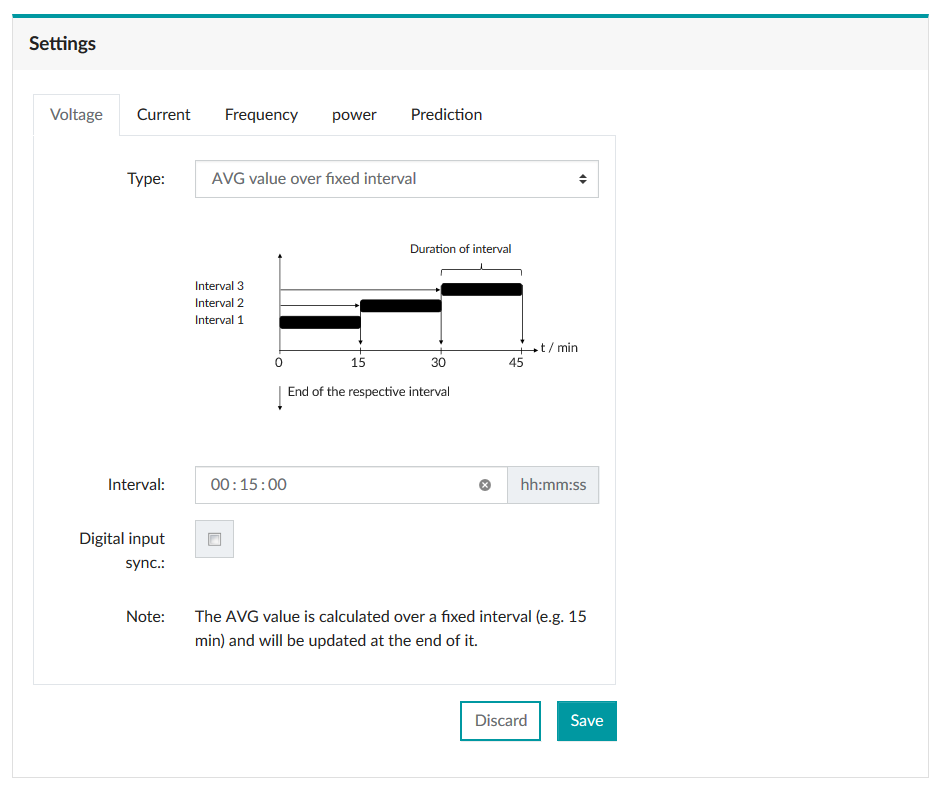
|
Settings |
|
Synchronization via Digital input:
The previously set interval for determining the mean value starts with the positive edge at the digital input. 2 scenarios are now possible:
- Once the interval has elapsed, the generated average value is transferred to the register and displayed. The determined value remains in the register until another measuring interval has elapsed after a new synchronization pulse at the digital input.
- If synchronization is performed again at the digital input before the set interval has elapsed, the average value (generated at this time) is transferred to the register and displayed. The new synchronization pulse starts the interval and the measurement again.
This function is used, e.g., when energy requirements have been defined that are not to be exceeded. When the average values are not synchronized, the measuring results might not correspond to the relevant energy requirements.
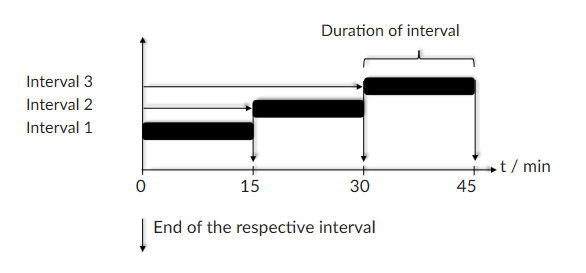
AVG over fixed interval (fixed block)
|
Interval with fixed measuring interval length |
The intervals follow each other consecutively at the measurement interval length. The requirement is calculated and updated at the end of each interval. |
Rolling average value (rolling block)
|
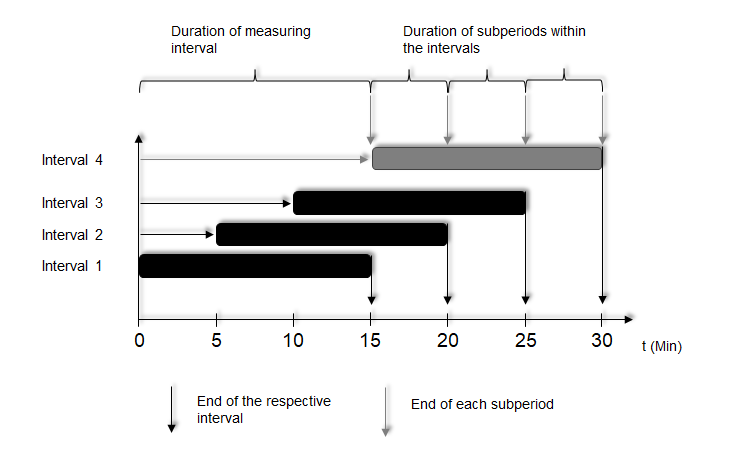
Interval with rolling block |
There is a set interval and a subinterval. The subinterval has to be an divisor of the interval and subinterval may fit into interval max. 60 times (interval/subinterval <=60). Example: If the selected interval is 15 minutes, three 5-minute subintervals have to be selected to match it. The average value is generated and updated at the end of each completed subinterval. |
Sliding average value (sliding block)
|
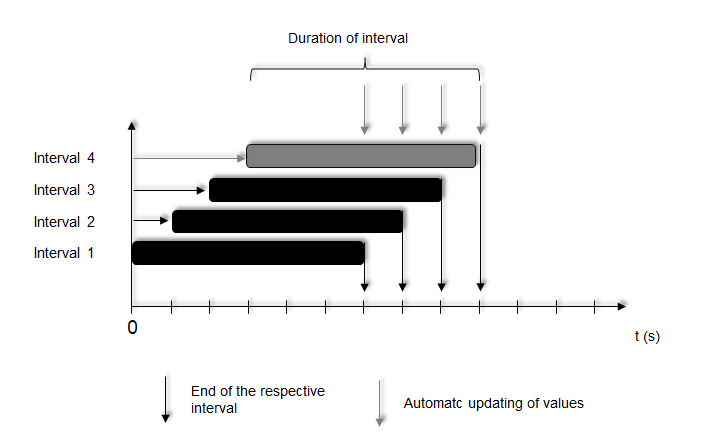
Interval with sliding measuring interval length |
The intervals slide and have a set measuring interval length. The average value is generated and updated with the sliding speed. During each update, the average is generated for the last completed interval. |
Related topics